Scratch Card Stickers, Business Scratch Cards and Loyalty Cards
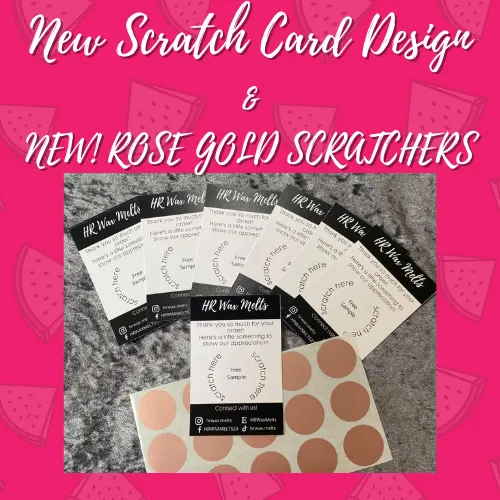
 Scratch Card Personalised Packaging Insert (Let us know scratcher colour, Gold, Silver OR Rose Gold)
Scratch card stickers are small labels with a silver or gold coating that rubs off to reveal a message, a code or a prize. Stick one onto a card, flyer or thank-you note and a plain piece of stationery becomes something people actually play with. Most are round, between 20 mm and 30 mm across, and 25 mm is the common choice because it covers a short line of text without crowding a business card.
This page explains how they work, where they earn their place, and what to settle before you design anything.
How scratch card stickers work
The printed message sits underneath. A layer of scratch-off coating goes over the top, usually a latex-based ink that lifts with a fingernail or a coin. Some are applied as a sticker you place over a printed area. Others are printed directly onto the card.
The sticker route is far more flexible. You print your cards normally, handwrite or pre-print the hidden message, then cover it. That suits small runs, where 50 to 200 cards is typical and a custom print job for each design would not make sense.
Silver, gold or a custom colour
Silver is the classic and the easiest to recognise as a scratch panel. Gold looks warmer and works well on kraft or cream stock. Printed colours are possible, but a coating that does not look scratchable can leave people unsure what to do, so keep the surface plain and add a small prompt such as "scratch here".
Business scratch cards that people keep
A business scratch card is simply a card with a hidden reward. The reward is often a discount, a free extra or a small prize, and the odds are set by you. Many small sellers make most cards a modest win, such as 5% off, and one in fifty a larger one.
They work best in three places: inside parcels, handed over at a market stall, and at the till. Inside a parcel, a card with a scratch panel is often kept for days, where a standard flyer is binned in seconds.
A few practical points matter more than the artwork:
- Print an expiry date, often 30 or 60 days, so offers do not run forever.
- Keep the hidden text short, ideally under 20 characters.
- Use a thicker stock of about 350 gsm so the card does not buckle under scratching.
- Test a sample by scratching it with a coin, then with a nail.
If your cards sit alongside branded labels, matching them to your business stickers keeps the whole parcel looking consistent.
Personalised loyalty cards
Personalised loyalty cards solve a different problem. Instead of one surprise, they track repeat visits. The standard layout is a credit-card-sized card, 85 x 55 mm, with 8 or 10 spaces for stamps or stickers. Ten is usual for coffee and treats, while 6 to 8 suits services that cost more.
The reward should arrive fast enough to feel reachable. If a customer needs 12 visits for a small freebie, most cards end up forgotten in a wallet.
Mixing loyalty and scratch
A neat hybrid puts a scratch sticker on the final space. After the last stamp, the customer scratches to see their reward, which gives the finish a small moment of its own. It costs a few pence per card and takes seconds to apply.
Other card ideas that pair well
Scratch panels are not limited to offers. A card with a hidden message can reveal a packing note, a care tip or a personal thank-you. Some sellers use them with affirmation cards, hiding the daily line under the coating so the reader chooses when to look.
Safety inserts are a more practical case. Cleaning and household products often ship with a small card of instructions, and a scratch layer can hide a discount code beside it, such as on a hoover freshener card tucked into a parcel.
What to check before printing
Order of work saves money. Design the card first, mark the exact panel position, then buy stickers sized to fit with a 2 mm margin. Pressing the sticker down firmly for 10 seconds helps adhesive bond to coated or matte card, while very glossy card can resist it, so test first.
Store finished cards flat and away from damp. Moisture and friction in a bag can wear off the coating before the customer has even opened it.
Frequently Asked Questions
Can I make scratch cards at home?
Yes. Print your card, write or print the hidden message, then cover it with a scratch-off sticker. For larger batches, a sheet of pre-cut stickers makes it far quicker than painting on a coating by hand.
What size scratch sticker fits a business card?
A round sticker of 20 to 25 mm fits comfortably on a standard 85 x 55 mm card. That leaves room for your logo and contact details around it.
Will the coating rub off in the post?
Good quality coating stays put in normal handling. Slip the card inside a sleeve or fold it within the parcel so it is not pressed against other items.
How many stamps should a loyalty card have?
Between 6 and 10 works for most small businesses. Fewer stamps suit higher priced items, and more than 10 tends to reduce completion.