Personalised Scratch Cards for Packaging Inserts: Gold, Silver or Rose Gold
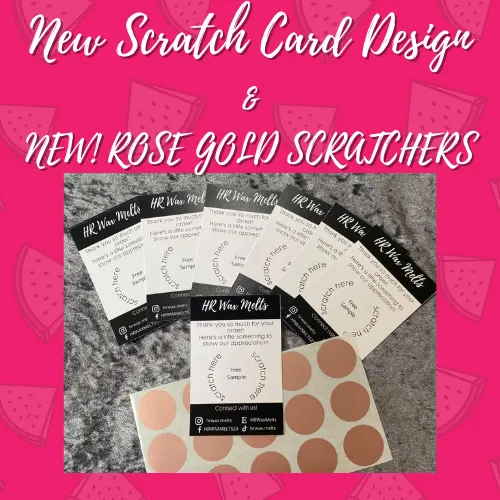
Personalised scratch cards are small printed inserts with a panel that the recipient scratches off to reveal a message, a discount code or a prize. Small businesses slip them into parcels because they turn the opening of a box into a tiny event. Most are credit card to A6 size, printed on thick card, with a metallic scratch layer over the hidden text.
What personalised scratch cards are used for
The most common use is a thank you with a reward underneath. A shop might print a repeat order code under the scratch panel, say 10% off, and the customer only sees it after scratching. It costs very little per card, usually around 10p to 30p each depending on quantity and size.
Other uses are worth considering:
- Revealing a free gift or a prize tier in a giveaway
- Asking for a review, with the link or QR code hidden underneath
- Announcing a new product launch or a pop-up date
- Gender or surprise reveals for events
Candle and wax melt sellers like them because the card sits flat on top of tissue and does not crush anything. Sellers of gifts do the same, often tucked into an 18th birthday box or similar presentation box before it is closed.
Choosing a scratcher colour: gold, silver or rose gold
The scratch layer is a foil-like coating, and the colour changes the whole feel of the card. Gold looks warm and festive and suits black, cream, deep green or burgundy designs. Silver is cooler and works well with blues, greys and white. Rose gold is softer and sits best with blush pink, terracotta, sage and anything aimed at a beauty or wellness buyer.
My advice is to pick the colour that contrasts least with your brand palette, not the one that stands out most. A rose gold panel on a bright red card looks muddy. Gold on the same red looks deliberate.
How to design personalised scratch cards that work
Keep the scratch area clear of detail. Anything printed underneath should be plain, high contrast text, and a panel of roughly 40 x 15 mm is enough for a short code. Larger panels take longer to scratch and flake more.
Artwork basics
Supply artwork at 300 dpi with about 3 mm of bleed. Mark the scratch panel position on a separate layer so the printer knows where the coating goes. Text close to the edge of the panel may get partly covered or look clipped, so leave a margin of at least 2 mm.
What to write under the panel
Short beats clever. A code such as THANKS10 is easy to type, and a QR code works if it is printed no smaller than about 20 mm square. Check that a QR code scans after a test scratch, because residue can interfere with some phone cameras.
Protecting and presenting the card in the parcel
A loose card can rub against other items and lose its coating in transit. Place it flat under the lid, or wrap the contents in tissue and lay the card on top. Some sellers use personalised vellum paper as an outer layer, which shows the card faintly through it and builds a little curiosity before opening.
If you already include care leaflets, keep the scratch card separate so it is not the first thing a customer discards. Products with instructions, such as scented items, often pair well with cards like Car Diffuser Instruction Cards, with the scratch card sitting on top as the friendly surprise.
Scratch cards often travel in the same parcel as car fresheners, so see what is a diffuser on a car and how its instruction card should read.
Quantities, lead times and cost
Minimum runs vary, but 50 to 100 cards is a common starting point for small sellers. Expect production to take roughly 3 to 7 working days, plus postage. Prices are indicative only and drop noticeably once you pass 250 cards, so if you will use them every month, a larger run is cheaper per card.
One practical point: scratch coatings are not forgiving about reprints. Proof the text twice, because a typo in a code is impossible to fix once the panel is applied.
Frequently Asked Questions
Can I choose different scratch colours in the same order?
Usually one colour applies to each print run, so mixed colours mean separate batches. If you want two looks, such as gold for regular orders and rose gold for gifts, plan two runs. Check the specification of your chosen printer first.
Will the scratch panel come off in the post?
A properly cured panel survives normal handling. Problems come from friction against rough items or from cards bent in a thin envelope. Keep the card flat and protected by tissue or a layer of paper.
Can I print a unique code on every card?
Variable data is possible with some printers, but it adds cost and usually needs a minimum run of several hundred. For small batches, most sellers use one shared code and limit it by date or order value instead.
What size should a scratch card insert be?
Credit card size, about 85 x 55 mm, fits almost any parcel. A6 (105 x 148 mm) gives more room for branding but can feel large in small boxes. Pick the size by the smallest package you ship.