Reed Diffuser Combined Label for Back of BOX - Your logo, 25% CLP (Augeo) & Usage Directions - Available in varies sizes
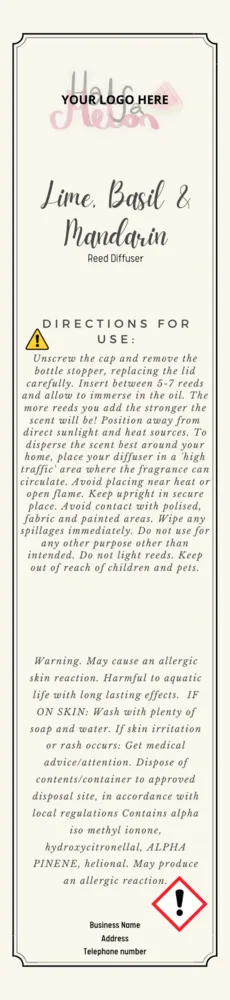
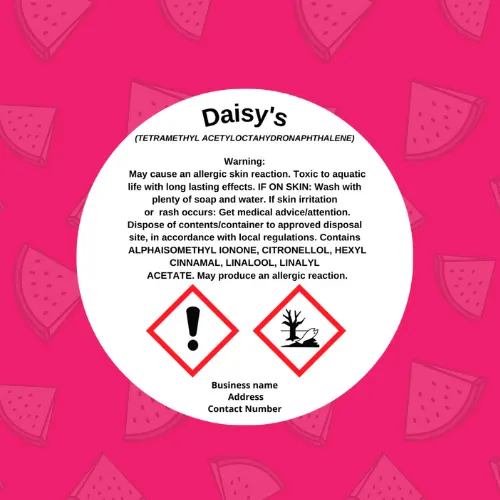
A combined label puts your logo, the CLP hazard information and the usage directions on one sticker, applied to the back of the reed diffuser box. For most small makers it is the simplest way to meet labelling rules on **CLP labels for reed diffusers** without cluttering the front of the pack. This page explains what goes on it, how big it should be and where people usually go wrong.
What a combined reed diffuser CLP label contains
Three blocks share the space. The top carries your logo or brand name. The middle holds the CLP panel. The bottom holds the usage directions, which customers actually read.
The CLP panel is the legal part. Depending on the fragrance oil and the base, it normally includes:
- the product identifier (for example, the name of the diffuser and the fragrance)
- any hazard pictograms, printed at no smaller than about 10 x 10 mm
- the signal word, such as Warning
- hazard and precautionary statements
- the supplier name, address and phone number
- the nominal quantity, for example 100 ml
The supplier details are your own and must be filled in by you. Fragrance suppliers provide the classification and the exact wording in their safety data sheet, so copy from that rather than from a similar product.
The 25% CLP label and the Augeo base
A "25% CLP" label is a layout where the regulatory text is set within a reduced area, designed around products with a small pack and a low-hazard base. Many diffuser makers use Augeo, a solvent that is usually treated as non-hazardous or low hazard, and pair it with fragrance oils at modest percentages. The label then only needs the statements the final blend triggers.
Always check the blend. A skin sensitiser in the fragrance can bring in a pictogram and an allergen statement even when the base is mild. Get the safety data sheet for each scent and do not assume one label fits all your fragrances.
Diffuser box labels: sizes and placement
Most diffuser boxes are slim and tall, with a back panel of roughly 50 to 70 mm wide and 120 to 180 mm high. A combined label in the region of 45 x 100 mm up to 60 x 150 mm covers the usual range. Measure the flat panel only, and leave a 2 to 3 mm margin so the edge does not curl over a fold.
Matte white paper stickers print crisply and take a black text layout well. Text under about 6 pt becomes hard to read after printing, so if the wording will not fit, go up a size rather than shrinking the font. Boxes with a soft-touch or varnished finish can make adhesive lift, so test one before you label a batch.
Reed diffuser packaging: where the label sits
The front of the box carries the branding and fragrance name. The back carries the compliance label. Putting the legal text on the back keeps the front clean and still lets a buyer find it in seconds.
If you also sell bottles without a box, the same information has to appear on the bottle or on a swing tag. Scented hoover discs and room sprays follow similar rules, and a separate layout for scented hoover discs is a better idea than reusing a diffuser label, because the quantity and use text differ.
Reed logo and branding on the label
People searching for a reed logo are often after a small mark that sits above the legal block. Keep it simple: a single colour version of your logo, about 25 to 35 mm wide, prints cleanly and does not compete with the hazard pictograms. Black on white is the safest choice, as red-bordered pictograms need to stay visible.
Pictograms printed in colour have to keep their red diamond border, so avoid putting them over a tinted background or a photograph.
Usage directions that belong on the label
Short, numbered steps work best. Something like this fits in about 40 words:
- Remove the cap and insert the reeds.
- Turn the reeds after a day or two to refresh the scent.
- Keep out of reach of children and pets, and away from polished surfaces.
- Do not drink. If swallowed, seek medical advice.
Keep the same wording on every label so that customers see consistent guidance across scents. The same approach applies to your wider packaging, such as outer box labels and seals, and to anything that carries a sender line, for instance personalised return address labels ireland if you post parcels yourself.
Frequently Asked Questions
Do I need a CLP label on a reed diffuser?
If the finished mixture is classified as hazardous, yes. Even for a low-hazard blend you still need the supplier details and the quantity. Check each fragrance safety data sheet to be sure.
Can I use one label for every scent?
Only if the hazard classification is identical across scents, which is rare. Allergens and sensitisers differ between fragrance oils, so most makers keep a separate label file for each fragrance, with a shared layout.
What size should a back-of-box label be?
Measure the flat back panel and subtract about 5 mm in each direction. For typical slim boxes this lands between 45 x 100 mm and 60 x 150 mm. Larger boxes can carry a bigger label with bigger type.
Is the pictogram size fixed?
It depends on the container volume. For small packs, the minimum is usually about 10 x 10 mm, and the diamond must stay clearly readable. Always check the current guidance for your pack size.